





Financial freedom starts with your mindset

It's more about how you think about money, less about what you have.

Adult man contemplating and drinking coffee at home

What would it feel like to think about money without the weight of it?

To feel calm and confident. Like money is a tool you understand and trust, rather than something that happens to you.

Most of what you've heard about money your whole life has been about competence. Whether you're "good with money" or not. Whether you've done the right things. 

But we think about money differently. We believe that financial freedom starts with a conversation around your own financial health and well-being. 

Financial freedom isn't a scorecard, a checklist, or a set of rules you're either following or failing. It's a state of being. It's what shows up when you can meet today without bracing for tomorrow, when your choices reflect what actually matters to you, and when money stops being a source of anxiety and overwhelm.

If that sounds far away from where you are right now, you are not alone. Our members who now live with greater financial wellness once experienced financial stress. They were uncertain about where to start or believed they didn't have enough money, time, or energy for it to make a difference. Those aren't character flaws; they're part of being human with a busy life. The difference between where they are now and where they began is that they started to engage with their money differently and gave the journey the time and attention it asked for. 
Financial freedom isn't a number. It's a feeling.

The four elements of financial freedom: Where the work happens

Before we go further, it helps to have language for what we're actually talking about. At Tru Cooperative Bank, we think of your financial wellness as the experience of being at ease with your money, both in the day-to-day and when something unexpected lands. It's the sense that you're on track for what matters to you, with enough flexibility to enjoy the life you're building along the way.

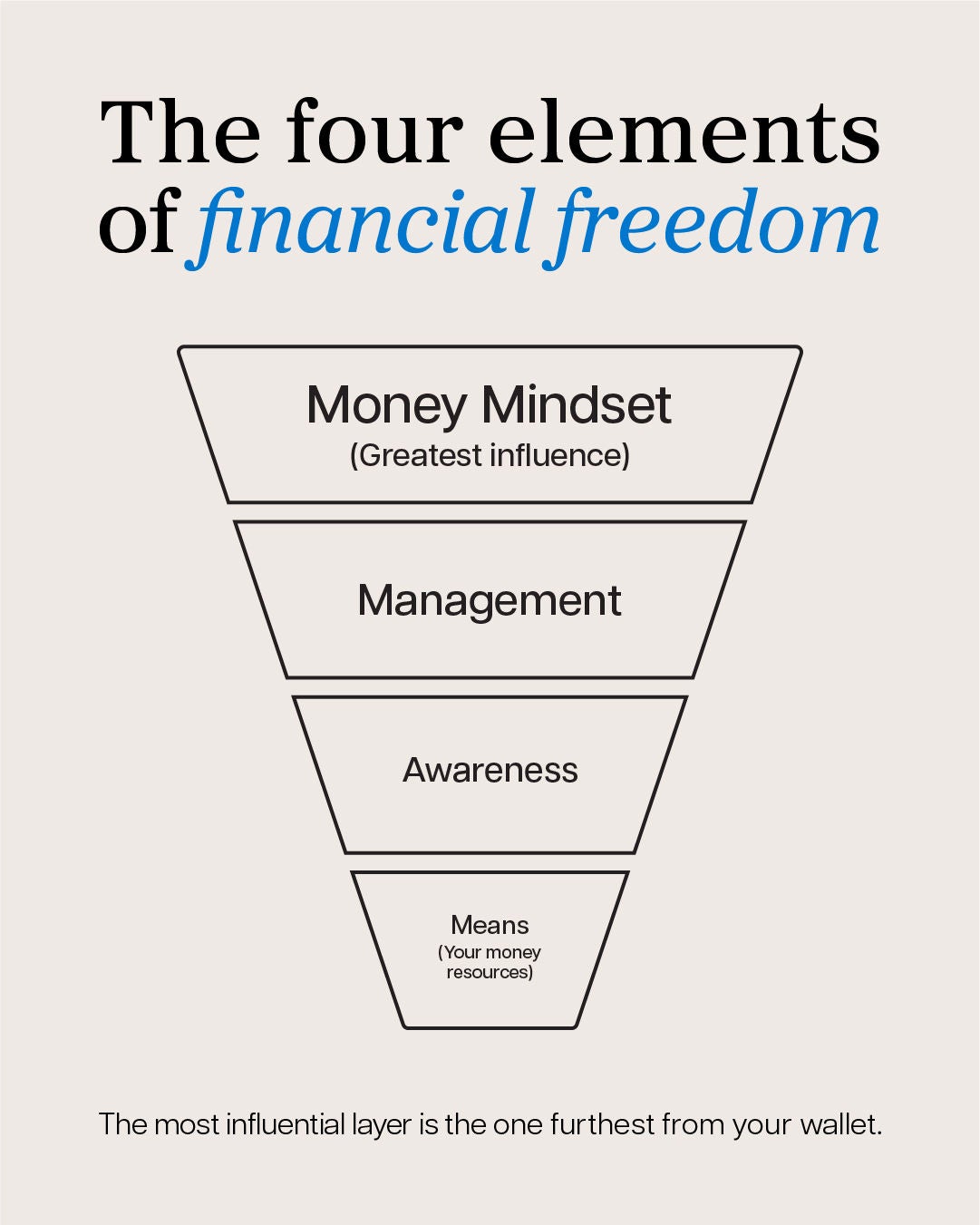
Underneath that experience are four elements that shape it:

  • Means: The actual money you earn, hold, and have access to.
  • Awareness: How well you know your own numbers and understand the financial world around you, from credit to investing.
  • Management: The systems, habits, and small daily decisions that, over time, compound into your financial life.
  • Money Mindset: The identity you hold around money, the beliefs you carry, and the stories you've told yourself about what kind of person you are with money and what's possible for you.

If you picture those four elements as an inverted triangle, the narrow bottom represents means, and the wide top represents mindset, where the real leverage in your financial life lives. It's tempting to assume your actual money, your means, is the part doing the most work. It isn't. However, the widest, most influential layer is the one furthest from your wallet.

Money mind set infographic

Money mindset: The story you're carrying, and why it can change

This is why we start with mindset. 
 
If you're sitting with real financial pressure right now, mindset work can sound like a luxury. It isn't a substitute for paying a bill that's due. It is, however, what eventually changes your relationship to bills altogether. 

The members who move from financial stress to financial wellness almost never do it by income alone. They do it by first changing how they think about money and letting the rest follow.

Focusing on the layer where the leverage is most impactful becomes important.  

Financial freedom begins with how you think about money. That mindset shapes what you value. Your values influence the goals you pursue. Your goals give direction to the plans you build.

Mindset → Values → Goals → Plan

Each step builds on the one before it. Together, they create a healthier, more intentional relationship with money, and that's where lasting financial freedom begins.

Step 1: Changing how you think (Mindset)

Your money mindset is the collection of beliefs, emotions, and experiences that shape your financial decisions, usually without you realising it. It's the inner voice that says, "I can't afford that" or "I'm not good with money."

It can also be a physical reaction, like a tightening in your chest when you check your bank balance. It's the reason two people with the same income can have completely different relationships with their money.

You didn't sit down one day and choose how you think and feel about money. Your money mindset was built without you noticing, by the household you grew up in, the conversations (or silences) around money, and the cultural messages you absorbed about success and security. 

You didn't choose this mindset, but it isn't fixed. Once you can see it clearly, you open yourself up to the opportunity to design and build a new one. 

So, the question becomes "what story am I carrying, where did it come from, and is it still serving me?"

For many people, the dominant story is one of scarcity - there isn’t enough money. Scarcity narrows your attention, makes financial decisions feel heavy, and pushes you toward either over-controlling your money or avoiding it altogether.

Some scarcity is real. Sometimes there genuinely are more demands on a paycheque than there is paycheque to meet them, and pretending otherwise would be unreasonable. But some scarcity is inherited. It's a lens we look at money through, even when our actual circumstances would allow us to see things differently, because it was installed years ago, and we've never thought there was another way.

The opposite of scarcity isn't forcing optimism or pretending things are fine when they aren't. Rather, it's a shift toward what we'd call sufficiency: the experience of recognising that what you have and who you are is enough for what you need. The feeling of enough is something we build for ourselves by getting clear on what we really need, separate from what scarcity has trained us to chase.  

From that clarity, money decisions start to come from intention rather than from the urgency and defensiveness that scarcity creates. You may have already felt this in small moments without naming it. 

That shift toward sufficiency starts with one move: noticing. Noticing the story you've been telling yourself, before deciding whether to keep telling it. From there, the shift takes root as you choose to be intentional with your money

You didn't choose your money mindset, but it isn't fixed.

Step 2: Filtering what matters (Values):

Mindset gives you a clearer view of how you've been thinking about money. The next question is what you actually want your money to be doing in the first place. That's a question of values.

Your values are the things that matter most to you - they are your internal compass, guiding your decisions. The things that, when honoured, leave you feeling like the best version of yourself, and when ignored, leave you with a quiet sense that something's off. Freedom. Security. Family. Adventure. Generosity. Creativity. Stability. Contribution. Different lists for different lives, but every meaningful list is curated to the few values that are most important to you and a life you love.

This is where noticing comes back in. Most of us have never sat down and asked what we actually value, rather than what we picked up from the people around us or what we chase because it's what success is supposed to look like. The practice is to notice what you value - the moments in your life when you feel most alive, most yourself, most grounded. 

Once you know what you value, using your money to live into those values gives it meaning. 

Step 3: Making the future real enough to move toward (Goal)

Values tell you what matters. Goals turn that into something your money can do. 

Values give meaning. Goals give motion.

A financial goal is a value made specific. It's the moment "family matters to me" becomes "I want to take two weeks off this summer to be with my kids," or "freedom matters to me" becomes "I want to be able to walk away from a job I don't like."

The value is the why. The goal is the what, the when, and the how much.

Without a goal, the value remains abstract or arbitrary, and your money lacks direction and is hard to stick with when life pushes back.

One of the most powerful outcomes of setting goals is that they change the experience of saying no.

Most of the messaging around financial goals is built on restraint. Don't spend on this. Cut back on that. The math is correct, but the framing is wrong, because restraint is exhausting and rarely lasts. A good goal flips that. When you have something specific you're moving toward, every smaller financial decision becomes a question of options rather than denial. You're not skipping dinner out, you're choosing the trip. You're not giving up the new shoes, you're choosing the financial cushion that lets you breathe at the end of the month. The "no" gets quieter because the "yes" gets clearer.

This connects back to the alignment we talked about in the last section. The brain doesn't fight you as hard when it can see what it's working toward. A goal makes the future feel close enough to be real, and once it feels real, the small daily decisions that move you toward it stop feeling like sacrifice and start feeling like progress.

Step 4: Acting on what you see (Plan)

Think about doing a puzzle. The most useful thing you can have is the picture on the box. Without it, you're moving pieces around, hoping something fits. With it, every piece has a place to go, and you can see, even early on, which corners are starting to come together. Mindset, values, and goals give you that picture. The next part is what helps you actually start placing pieces. A financial plan.

A Financial Plan is just a tool. It doesn't judge you, decide for you, or tell you what you can or can't have. It helps you see your money clearly so you can act on what you see. A well-built plan isn’t about restriction; rather, it helps you confidently say yes, because you can see what your yes costs and what it makes possible.

A surprising amount of financial stress isn't really about not having enough. It's about not knowing. Not knowing what's in the account when a bill hits, whether yes to one thing means no to another, or whether you're on track. A simple, well-built plan replaces that not-knowing with visibility.

A plan doesn't have to be complicated to do this work. It just has to be honest and be a good fit for your life. A two-income household with kids will use a plan differently from a single freelancer. Someone paying down debt will lean on theirs differently than someone investing a surplus. The goal isn't a plan that looks impressive on paper, it's a plan that works in the life it's built to support.

A plan is one piece of the bigger picture of financial well-being we've been walking through. You don't have to build a plan today. But putting pen to paper, for anything you’ve learned so far today, is a great tangible place to begin.

The journey ahead: The next step is smaller than you might think

This article offers a different way of thinking about money. A sequence that puts your mindset before your tools, your values before your goals, and your goals before your plan. That order isn't accidental, and it's what most financial advice gets backwards. The technical pieces of money management aren't unimportant. They're just the wrong place to start. They work much better when there's something underneath them.

For now, the invitation is small. Notice the story you've been telling yourself about money. Notice what you actually value. Notice what goals you have for your life. Those small acts are where the change starts.

You don't need to arrive ready. You just need to arrive.

If that sounds far away from where you are right now, you are not alone. Our members who now live with greater financial wellness once experienced financial stress. They were uncertain about where to start or believed they didn't have enough money, time, or energy for it to make a difference. Those aren't character flaws; they're part of being human with a busy life. The difference between where they are now and where they began is that they started to engage with their money differently and gave the journey the time and attention it asked for. 

Money has more meaning when it serves your values.


Financial guidance

More on building your financial confidence

What is your money for?

Identify what matters most to you and learn how your values can guide clearer, more intentional decisions about earning, spending and saving.

Why managing money feels hard

Explore the human side of money, from stress and habits to fear and past experiences, and learn why simply noticing your barriers is a meaningful first step.

The three forces behind almost every money decision

Learn how scarcity, dopamine and anchoring can influence everyday money decisions, and how greater awareness can help you pause, choose and build new patterns.